CASA

Collaborative Adaptive Sensing of the Atmosphere (CASA):
A National Science Foundation Engineering Research Center

New! Click here for Science Teachers' 1-day Workshop on Weather, Earth Climate and Energy (WECE)

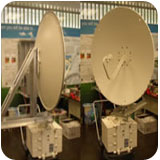
New antennaCASA, the Center for Collaborative Adaptive Sensing of the Atmosphere, seeks to revolutionize the way we detect, monitor and predict atmospheric phenomena by creating a distributed collaborative adaptive sensor network that sample the atmosphere where and when end user needs are greatest.  This system has the potential of having a profound impact on the society in terms of lives, property and the economy. 

Our goal is to dramatically increase the warning time and forecast accuracy for tornadoes, flash Diagram depicting current problem of under-sampling
of the lower atmosphere, where weather occurs, due to  the Earth curvaturefloods, land-falling hurricanes, and other airborne hazards that impact millions of people across the US every single day.  CASA will engineer an entirely new approach based on a dense network of low-power radars that overcome curvature blockage and achieve significantly enhanced resolution compared to today's systems.  The system will have a new generation of meteorological software that allows the radars to focus their beams down onto individual storms and actually track those events. The CASA concept is referred to as distributed collaborative adaptive sensing technology, or DCAS.

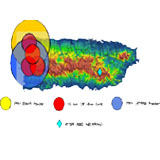
Preliminary location of Puerto Rico Network of DCAS radars The regions of the atmosphere most critical to our safety are inadequately sampled by today's observing systems. These regions include the lower third of the troposphere and, in particular, the atmospheric boundary layer. Potential hazards to public health and well-being - such as thunderstorms, tornadoes, snowstorms, and floods - form in these regions.  This is also where lofted radiological, chemical and biological agents are of potentially great concern.  Current observing approaches are based upon a long-established paradigm of widely-spaced functionally autonomous sensors that operate independent of phenomena observed. These systems are fundamentally constrained in spatial resolution and sensitivity, prevented by Earth's curvature from sampling the critical lower atmosphere, and are unable to measure thermodynamic states.

Our ERC proposes a revolutionary new paradigm in which transforming systems of distributed, collaborative, and adaptive sensing (DCAS) networks are deployed to overcome fundamental limitations of current approaches. Here, distributed refers to the use of large numbers of appropriately spaced sensors capable of high spatial and temporal resolution throughout the entire troposphere. These systems will operate collaboratively within a dynamic information technology infrastructure, adapting to changing conditions in a manner that meets competing end-user needs. These systems will achieve breakthrough improvements in sensitivity and resolution leading to significant reductions in tornado false-alarms, vastly improved precipitation estimates for flood prediction, fine-scale wind field imaging and thermodynamic state estimation for use in airborne hazard dispersion prediction and other applications.

UPRM MS student, Leyda León, operating a UMASS  W-band radar at CART site in Oklahoma Successful implementation of DCAS systems will require fundamental breakthroughs consistent with the NSF Technical Merit Review Criteria.  Among these breakthroughs will be integration and sharing of knowledge across disciplines; design and fabrication of low-cost, multi-beam, solid-state radars; creation of a systems-based architecture to organize sensing, computing, and communications resources; development of two-way end-user interface that dynamically target system resources; deployment of integrative test beds to validate assumptions and understand emergent system behavior; implement cross-linked hierarchical data storage and processing; and improved understanding of small-scale atmospheric processes.

 Hurricane Georges, 1998To achieve these breakthroughs, we have assembled leading engineering and computer science experts from the University of Massachusetts Amherst. They will work in partnership with scientists and engineers from the University of Oklahoma , Colorado State University and the University of Puerto Rico, Mayagüez, and corporate partners including Raytheon, IBM, Vaisala and federal and state government agencies to create the Center for Collaborative Adaptive Sensing of the Atmosphere. We will create scalable prototype test beds to demonstrate the potential for DCAS to revolutionize our understanding, detection, and prediction of hazardous atmospheric phenomena-with end users involved from the outset.

Graduate student Jorge Trabal, performing the terrainsurvey for survery finding the optimum location for radar-network sites CASA meets the NSF Broader Impacts Review Criteria through:  comprehensive education and outreach programs that introduce systems-based engineering to K-12 students via the mandated engineering/technology curriculum in Massachusetts, and serves as the mechanism for expanding participation by under-represented groups in engineering and scientific endeavors at all levels.  Further, it will engage first-responders and other end users through the provision of both technology and training.  CASA will address the observation, prediction and response of weather, an issue that affects between 10 percent and 30 percent of the U.S. gross national product.

UPRM will work in collaboration with UMass at Amherst, Colorado State University and University of Oklahoma in this new Engineering Research Center. Dr. Sandra Cruz Pol is the PI for the center at UPRM and the educator and remote sensing coordinator, Dr. José Colom is the Director and radar systems coordinator, Dr. Rafael Rodríguez is the antenna design coordinator, Dr. Walter Díaz is the social science coordinator, and Dr. Lionel Orama is leading a student led testbed in Puerto Rico.

The NSF award consists of $17M for the initial five years of a ten year program plus matching funding from the institutions and industry.

 
CASA is a multidisciplinary group lead by CASA UMASS.
 
  © 2005 CASA • University of Puerto Rico at Mayagüez.
Department of Electrical & Computer Engineering.
logo CASA